This section starts where the exhibition ends: with a work of anti-racism. But it also includes the challenges posed by long-standing and persistent visual stereotypes, even within images that attempt to challenge the racial hierarchies that underpin those stereotypes.
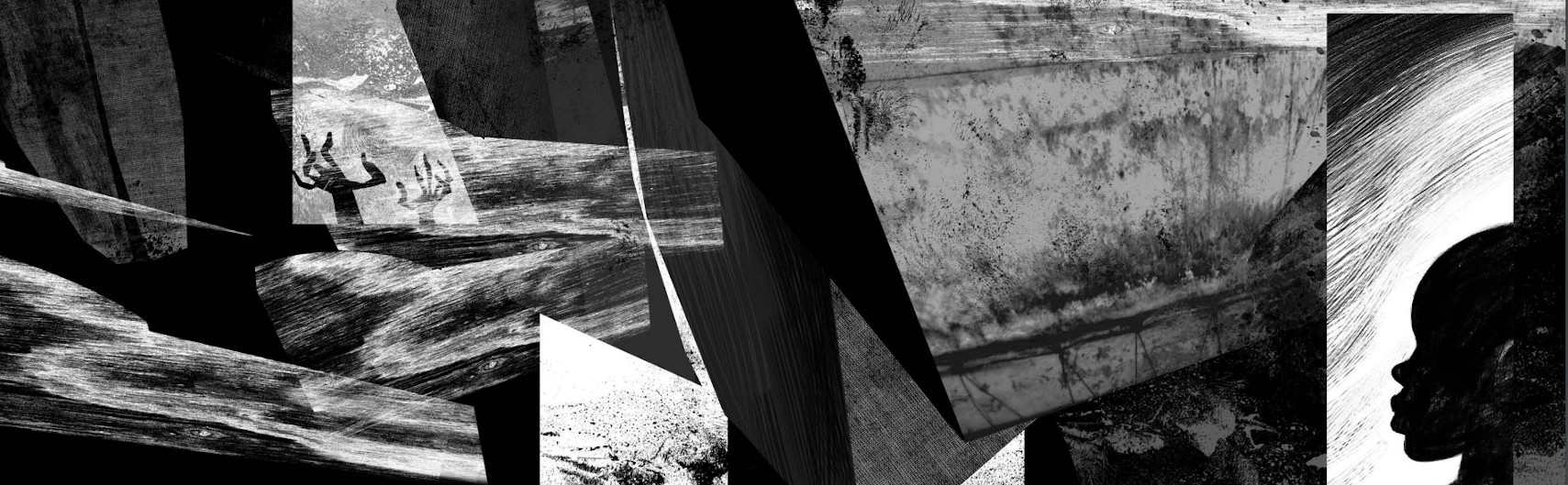
Frecuencia Negra is a graphic zine by Wilson Borja, a Colombian Afro-diasporic artist and member of Colombian anti-racist art collective Aguaturbia. The zine is an abstract reflection in visual form on the array of realities creating the frequencies of diasporic Black people, inviting us to oppose the stereotypes that stigmatise, criminalise, and dehumanise Black lives. Borja visually evokes the broad and heterogeneous spectrum of the frequencies of Black lives in different times and locations. The zine is an invitation to reflect on these possibilities under the effects of the irradiation of blacklight, following the critical-creative methodology proposed by Denise Ferreira da Silva (2016) as an aesthetic practice contesting the colonial, racial and cisheteropatriarchal matrix of the modern enlightened regime. In this way, this zine engages the flows and sequences of Black life, transcending the limits of the page and flowing towards a threshold: the potency of what-is-to-become.
Abeyamí Ortega

This one-page comic strip with six black-and-white panels shows a middle-class Black couple holding a party at their house. Everyone is dressed in formal evening wear. The wife introduces four white guests individually to her husband. He makes comments aside that ridicule each one and relate them to animals. He ends by saying that, to hold a party, he doesn’t see the need to turn his house into a zoo.
This 1923 comic strip by well-known comics artist Arístides Rechain (1888-1962) featured in a popular weekly Argentinian magazine, La Novela semanal, from 1922 to 1923 to advertise Dólar cigarettes. The Black couple are depicted using racist visual stereotypes globally current at the time. The comic strip often satirizes the aspirations of the Black family, who attempt to fit into Argentina’s predominantly white middle classes. The Black couple are often depicted as awkward, foolish or pretentious: their behaviour acts as a moral compass for the readers who are or aspire to be middle-class, showing them behaviours they should avoid. But in some cases, of which this is one, the Black couple are shown as more astute than their white guests, turning the tables of racism: one of the guests is even compared to a monkey, which has been an enduring image associated with Blackness in the vocabulary of racism. However, a savvy, amusing Black character of this type was also a stock figure in Latin American theatre and literature, so Rechain was employing another stereotype, albeit less brutal. Stereotypes are simplifications, but they can also be diverse and complex.
Peter Wade

This one-page comic strip with six black-and-white panels shows a Black man being questioned by a white man, with a young white child also in the scene. The Black man confirms he is from the Goajira (an area in the Caribbean region of Colombia), where he agrees with the white man that life is completely “primitive”. The white man asks if he likes children and he responds that he does but that “afterwards” they upset his stomach if he doesn’t take bicarbonate of soda.
This unsigned 1924 comic strip featured in La Semana cómica, a weekly Colombian magazine of humour and political satire published in the 1920s in Bogotá. It plays on the racist and colonial stereotype of the African as cannibal and depicts the Black man with highly racist visual stereotypes globally current at the time. In this example, the Black man is depicted as a threat to the white family, via the image of the innocent child faced with a terrifying bogeyman. The choice of the desert-like Guajira region as a place where Black people typically live in Colombia is unusual, as it is better known for the presence of Wayúu Indigenous people. This suggests that the magazine’s readers - probably from the Andean region around Bogotá - would accept the idea that any part of Colombia’s tropical Caribbean region could be home to Black people, who would also fit their idea of a “primitive” African person. In the 1920s, Colombia’s Caribbean region was often depicted as Black, tropical and very different from the country’s Andean interior, where Black people were not a common sight.
Peter Wade
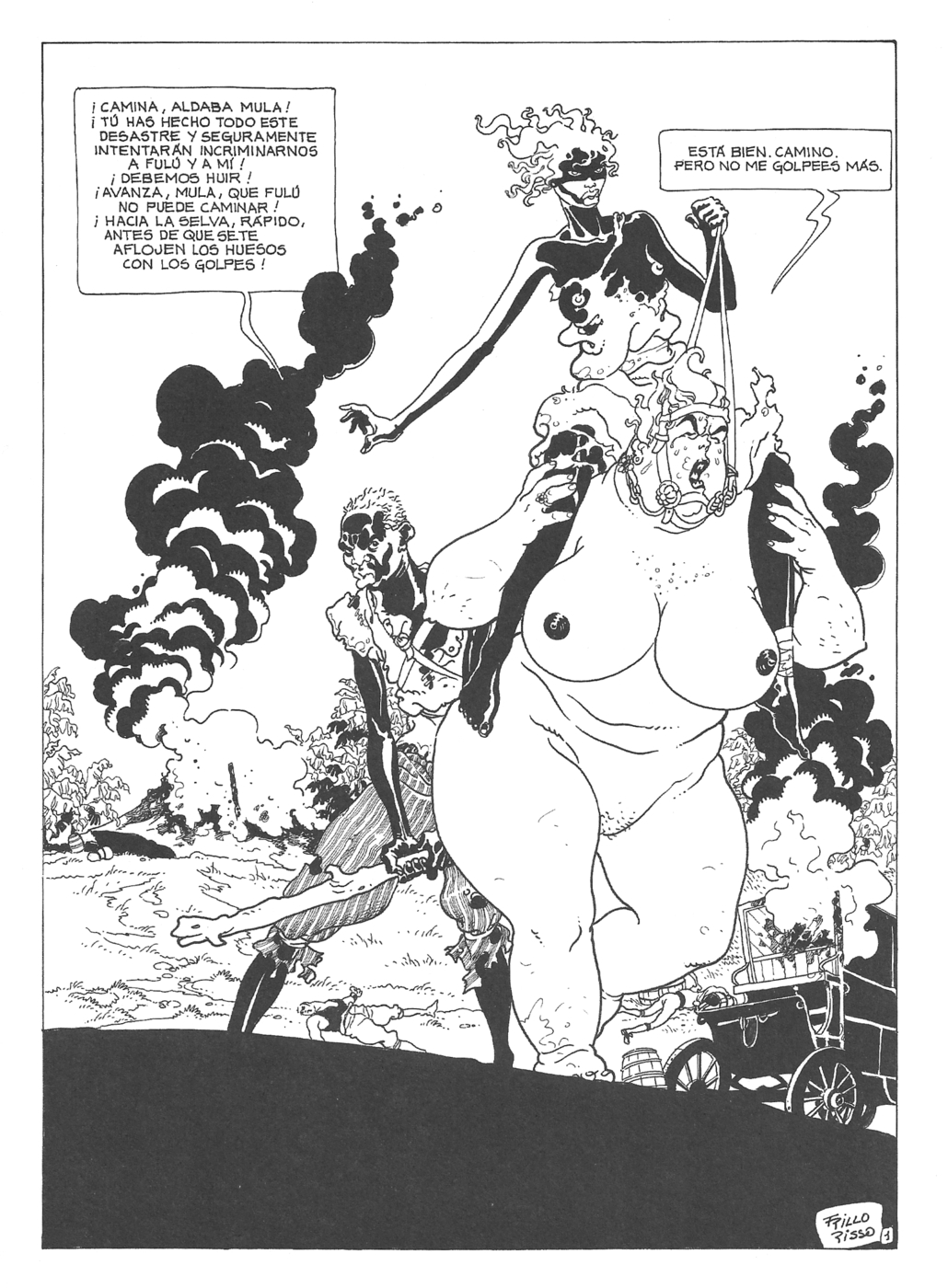
Fulú, written by Carlos Trillo and drawn by Eduardo Risso, is unusual for a twentieth-century Latin American comic as it has a Black woman as a protagonist, a slave who resists the brutal violence of the colonial Americas. Fulú might, in that sense, be seen as an effort to overturn long-standing racial hierarchies. But as Rocío del Águila and José Enrique Navarro point out, Fulú not only symbolises feminist resistance and agency, but is also the "object of an overwhelming graphic exploitation" (2018). Her resistance is, in part, based on the hyper-sexualised Black female body. In the pages depicted here, traditional racial hierarchies and tropes are inverted when Fulú mounts the white slaveowner, who previously tried to bite Fulú in an act of cannibalism, riding her with a harness into the haven of the forest. Both women’s bodies are exposed to the viewer’s gaze and are subsequently subject to diverse sexual fantasies, highlighting the complex intersectionalities that prevail in a world of inequalities shaped by the interplay of sex and race.
James Scorer

The one-page comic-strip with six black-and-white panels narrates how three well-off young men, while out on a drinking spree, buy carnival-style masks. One has a mask showing a caricatured African face. Arriving home very drunk, he goes to bed with the mask still on. In the morning, his mother comes into the bedroom with coffee, sees him asleep, mistakes him for a Black man, and screams in alarm that there are thieves in the house.
This 1901 image appears in Caras y Caretas, an Argentinian magazine of political satire and topical issues. Titled “carnivalesque episode”, the comic-strip by Uruguayan Orestes Acquarone (1875-1952), refers to a carnival tradition in the Americas in which ordinary white people dress up as Black people. (Indigenous people sometimes dress up as Black people; or Black people may impersonate even Blacker people or Indigenous people. Rarely do Black or Indigenous people masquerade as whites.) In the context of the carnivalesque upsetting of social conventions, this visual “role reversal” has been seen as undermining hierarchy, because white people become Black for a day. But it also reinforces racial hierarchy, because, first, the reversal only happens in one direction, with white people choosing to “black up”, while the opposite is very rare; and second, the reversal is superficial and very temporary. In this story, the transience of the reversal is the hinge of the joke. The masquerade “Black man” was acceptable during a temporary drunken spree in streets and public bars, but he has inadvertently moved into the normal daily life of a private family house, where the mother reacts with everyday and enduring stereotypes about Black people being thieves.
Peter Wade
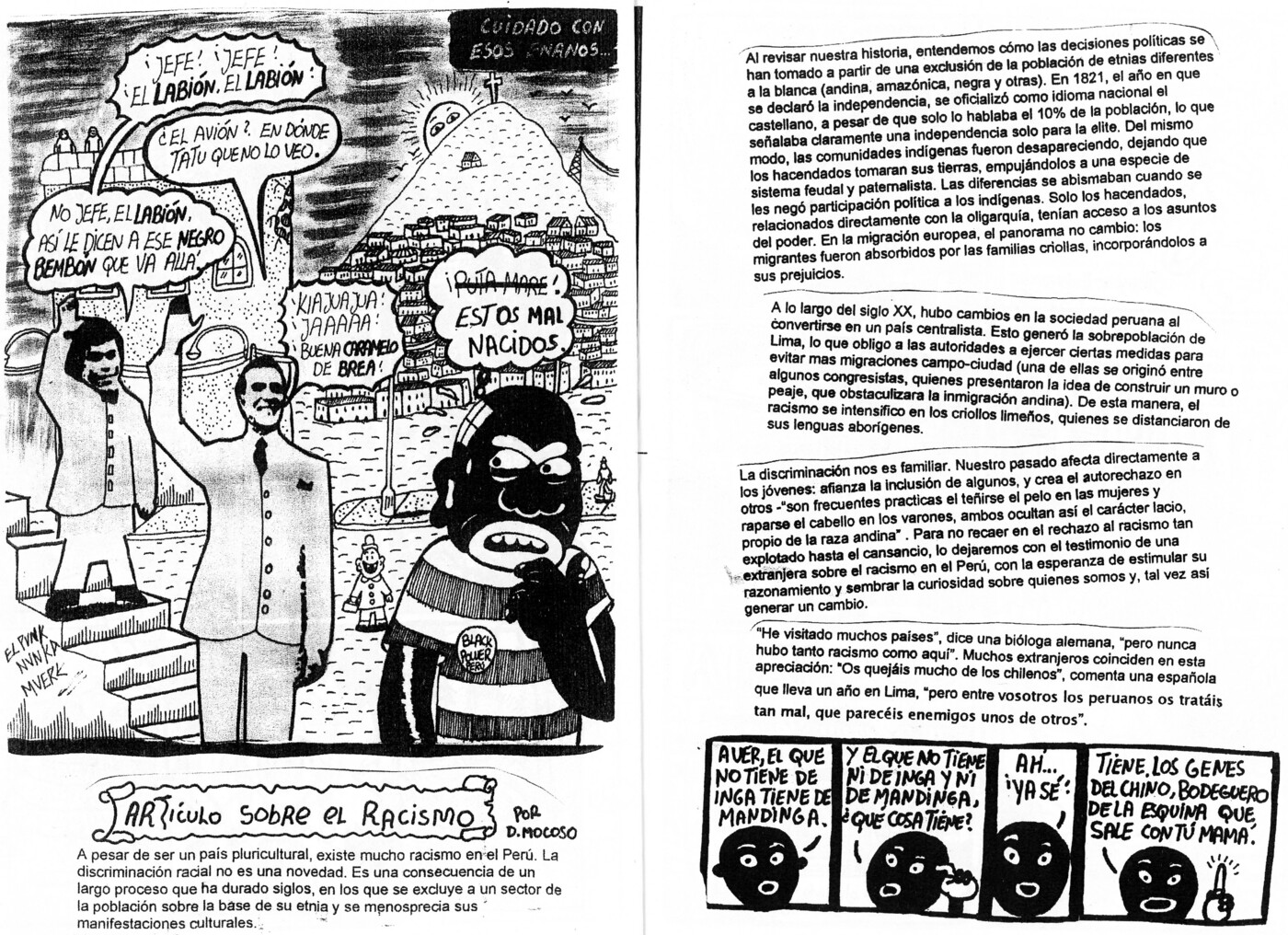
David Galliquio, has a caustic satirical style, seasoned with grotesquerie and a punk aesthetic (the pen name mocoso means snot-nosed). This 2013 text adopts a more moderate style and traces the historical roots and continued presence of racism in Peru. The text refers to racism against Indigenous peoples and not against the Black figures who dominate the page visually, which is odd considering Galliquio claims to have Black heritage. Does this reveal an internalised racism? Does Galliquio get away with using stereotypical images, familiar from a racist repertoire, through his combination of satirical irreverence and reasoned anti-racist discourse? Views will differ…
The closing comic-strip plays with the well-known Latin American phrase, “Whoever has no Inga (i.e. Indigenous ancestry) will have some Mandinga (i.e. African ancestry)”, which means no one can claim to be white. But what if I’m a person with neither Indigenous nor African parentage? Am I not white? No, says the cartoon character, because you have genes from the Chinese shopkeeper on the corner - who your mother goes out with! So everyone is mixed, one way or another. Again, a question hovers: is Galliquio playing dangerously with the anti-Chinese racism that is a common in Peru?
Peter Wade
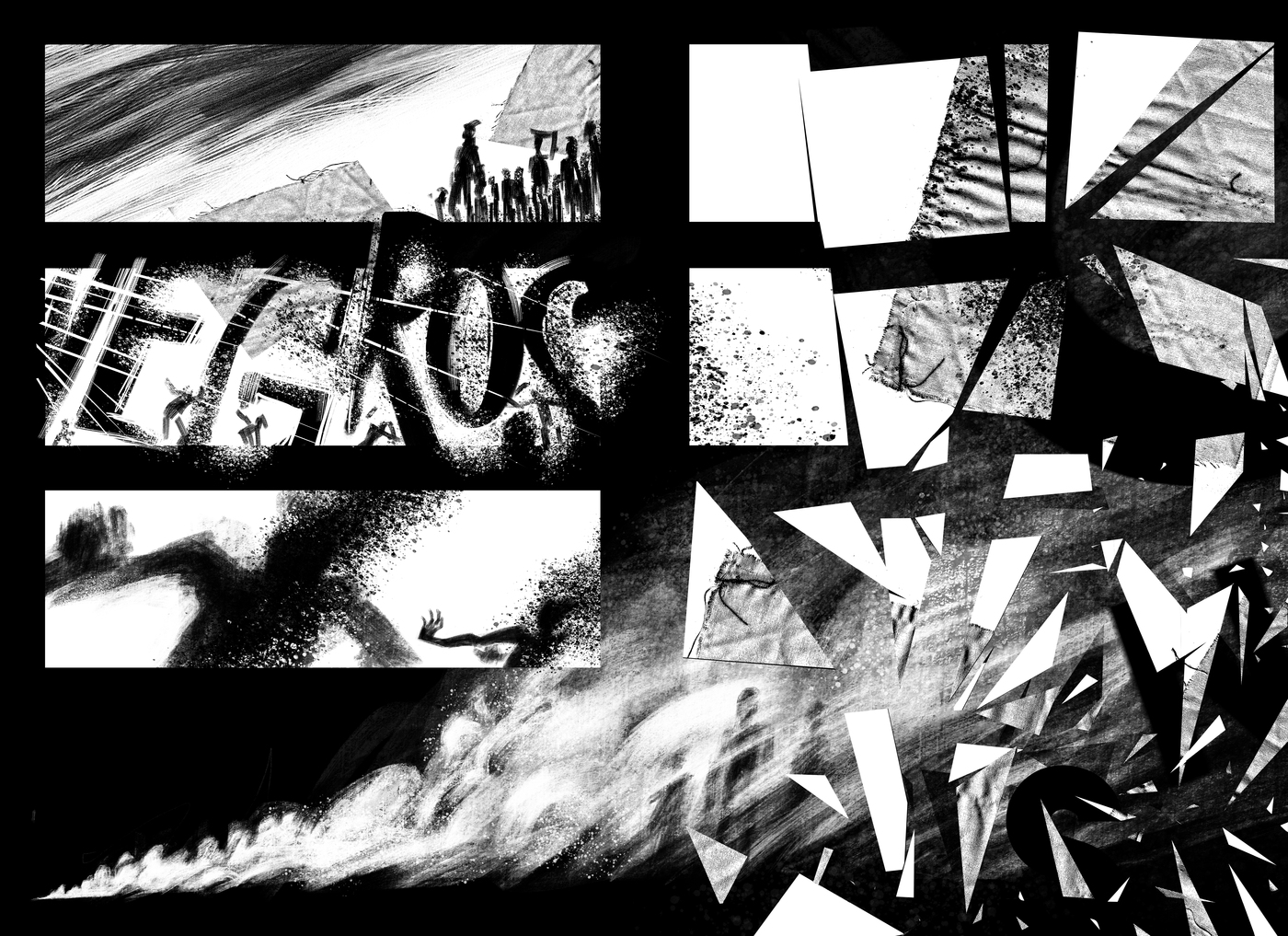
Shattering the normative borders of the page, this graphic zine by Colombian Afro-diasporic artist and member of Colombian anti-racist art collective Aguaturbia, Wilson Borja proposes an abstract visual meditation on Blackness and Black diasporic lives. Mobilising sequential art as a tool advocating for and empowering Afro-descendant populations, the artist's primary focus lies in deepening an understanding of Afrodiasporic communities through illustrations unsettling the limits of the page, a metaphor for discarding the limits imposed by dominant narratives that edit, make invisible, and limit Black and Afro-diasporic history. Instead, it centres a visual rendering evoking the shattering long-lasting violence of the Afro-diasporic experience, which started with the Transatlantic slave trade, and the life-affirming strength and persistence of Black lives, highlighting reverence for the sacred connection between the living and their ancestors.
Abeyamí Ortega