
British views of the Sikh Empire
This section explores two British accounts of the Sikh Empire: Osbourne's travelogue of The Court and Camp of Runjeet Singh and Cunningham's History of the Sikhs. Both of these works are written from colonial perspectives, capturing British fascination with the Sikhs, and providing insights into the complex interactions between the empires.
Lord William Godolphin Osbourne’s travelogue provides a unique first-hand account of his time at the court of Maharajah Ranjit Singh, founder of the Sikh Empire.
Military secretary to the Governor General of India, Osbourne formed part of an official British mission sent to secure an alliance with the Sikhs.
Osbourne records his conversations with the Maharajah and his observations on the wealth and power of the ruler, his famous gatherings, and the strength of the Khalsa army.
R38795
The travelogue contains sixteen of Osbourne’s own illustrations, including portraits of the Maharajah and other significant Sikh figures. A work of espionage, the text is peppered with comments about the future of the empire which shed light on Britain's imperial ambitions:
Self-preservation requires that the government of the Punjab should be either our own or friendly to us.
Lord William Godolphin Osbourne
Written by historian Joseph Davey Cunningham (1812-1851), this is a historical account of the Sikh people.
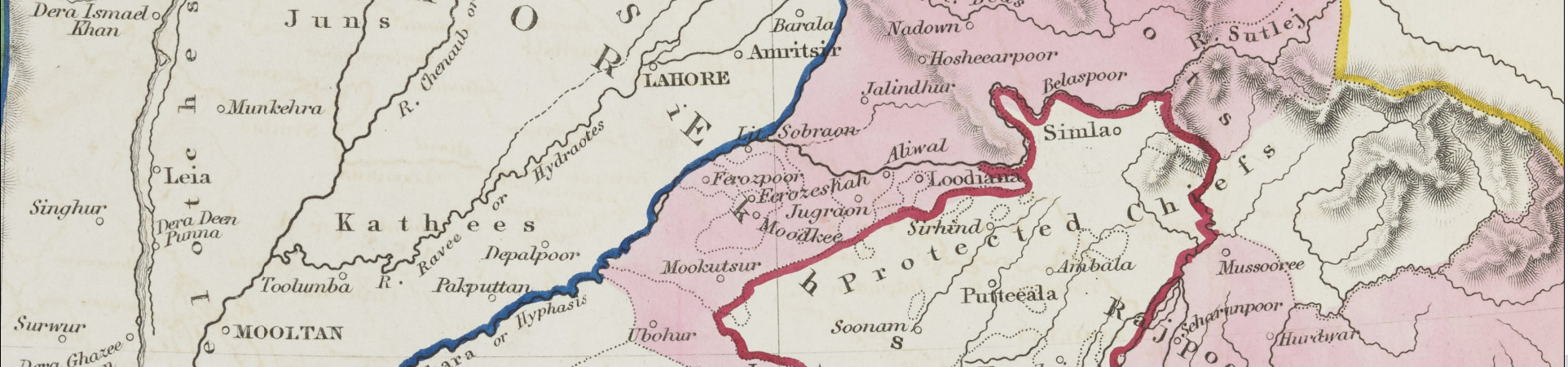
Cunningham’s text spans the origins of Sikhism in the late 15th century to the Anglo-Sikh wars of the 19th. Taken from the book, this map shows the political divisions of the Punjab following the first Anglo-Sikh War (1845-46).
Cunningham was an officer in the army of the East India Company, but was critical of the conduct of the British government and his army superiors towards the Sikhs during the Anglo-Sikh wars. As a result of this book, Cunningham lost his job as a colonial official and was publicly disgraced. The book was banned in India until the early 20th century.