
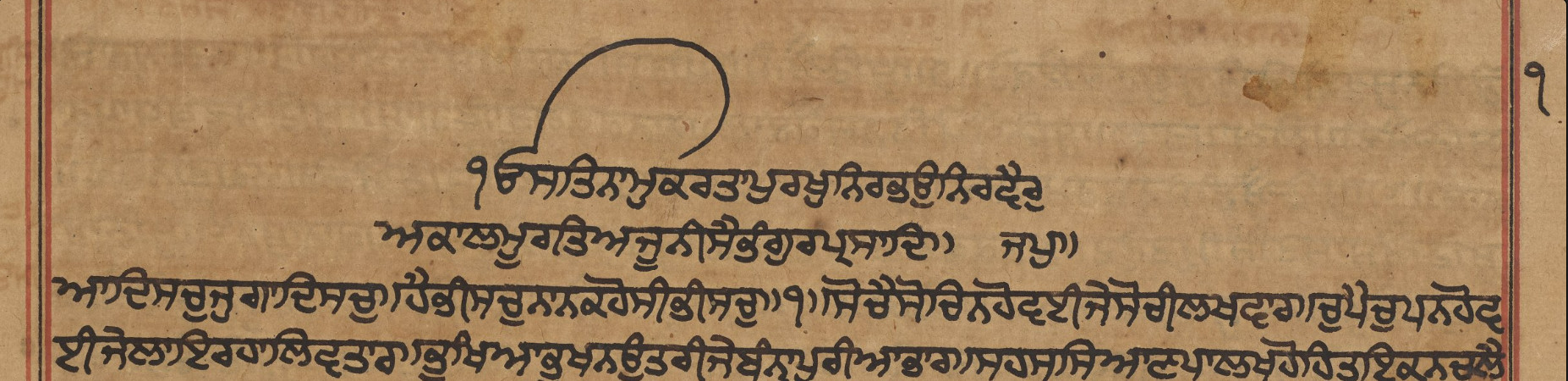
History of the Guru
This Guru Granth Sahib is believed to have been created between the late 17th century and the early 18th century.
Sri Guru Granth Sahibs often accompanied Sikhs into battle for spiritual guidance and protection. This Guru was carried by Sikh soldiers of the Lahore Durbar (Sikh Raj), and was thought to be present at the battle of Gujrat in 1849, the final conflict of the Second Anglo-Sikh War. This resulted in the end of the Sikh empire and independent Sikh rule in the Punjab.
It was at this pivotal battle that records suggest the Guru was seized by the British.
Illustration from The life and times of Queen Victoria depicting the Battle of Gujrat fought between the British and Sikhs.
Image reproduced courtesy of the Getty Research Institute, Los Angeles
urn:oclc:record:1048299327
The Guru was initially sold to Bernard Quaritch (1819 - 1899), a well-known London bookseller.
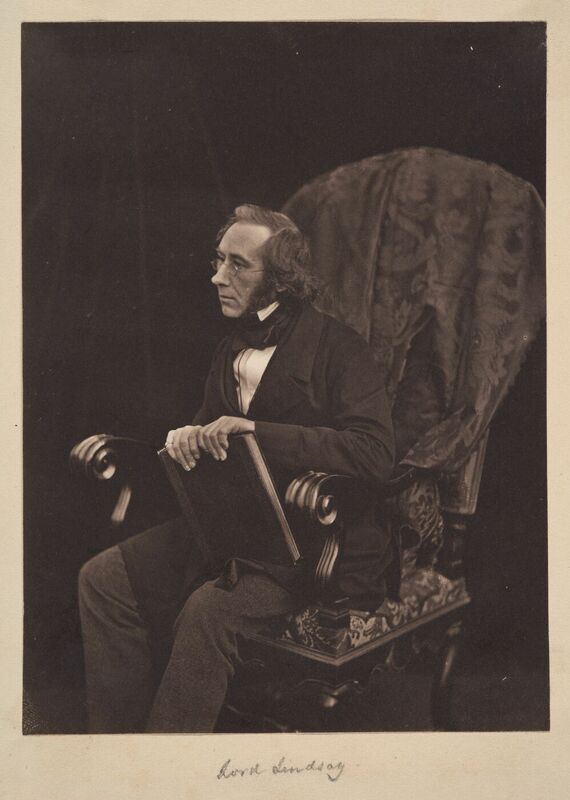
The Guru then passed into the hands of the Earl of Crawford, Alexander Linsday (1812 - 1880) in 1862, becoming part of one of the largest private collections in Britain, the Bibliotheca Lindesiana.
Image courtesy of University of St Andrews Libraries and Museums.
The Bibliotheca Lindesiana was purchased wholesale by Enriqueta Rylands (1843 - 1908) for £155,000 in 1901 for the John Rylands Library, where the Guru has remained ever since.
This printed catalogue slip, attached to the 'Handlist of Hindustani, Marathi & Punjabi Manuscripts', gives an account of the looting of the Guru.
Attached to this catalogue slip is a letter dated June 25, 1862, written by Reinhold Rost (1822-1896), a German orientalist and head librarian at the India Office Library in London.
It introduces the Sri Guru Granth Sahib as ‘a complete copy of the Adi Granth , the religious code of the Sikhs’. The Adi Granth, meaning ‘first book’, refers to the original text compiled by the fifth Guru, Arjan Dev Ji in Amritsar in 1604.
This extract exposes the ignorance of contemporary collectors and cataloguers. Sri Guru Granth Sahibs are crucially not Adi Granths, but living entities containing the finalised version of the scripture compiled by the tenth Guru, Guru Gobind Singh in 1708. The letter emphasises the value of the ‘manuscript’ and the fact that ‘complete copies of this work are very rare.’