
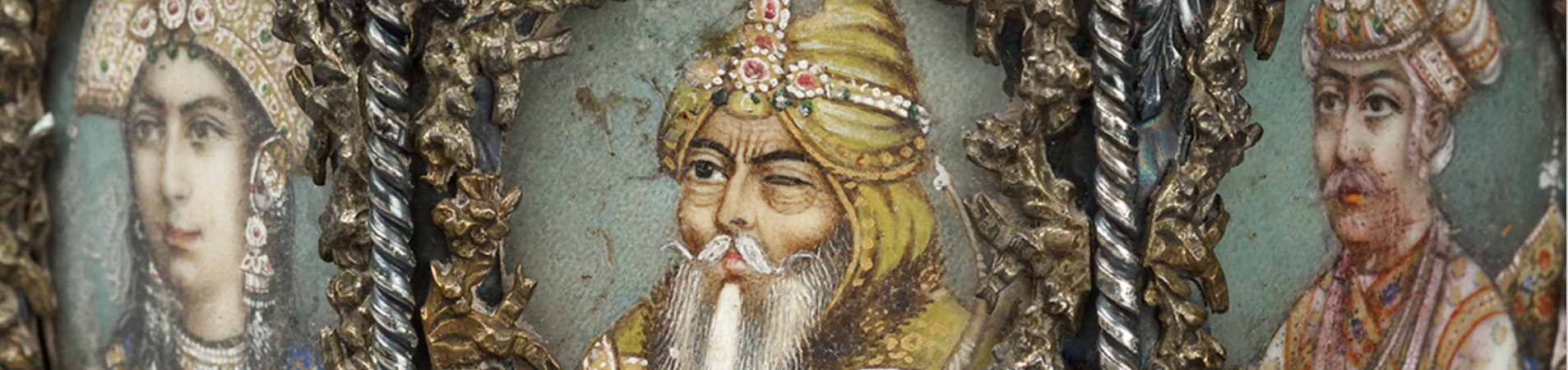
Casket ornately crafted with precious metals, ivory and jewels, with portraits of Mumtaz Mahal, Ranjit Singh, and the Emperor Akbar.

Visualising Sikh Culture

This section showcases unique visual items from Manchester Art Gallery and the Rylands collections. The Rylands and other British institutions hold material objects, as well as manuscripts, significant to Sikh culture and heritage. Displaying physical objects alongside early visuals enhances our understanding of Sikh culture, and brings the intwined histories of the Sikh and British Empires to life.

This casket features portraits of eight notable Sikh and Mughal figures, which were widely produced and copied between the late nineteenth and early twentieth century, particularly in Delhi.  

Ornately crafted with precious metals, ivory and jewels, this casket contains paintings of Maharajah Ranjit Singh (1780-1839) and Maharajah Gulab Singh (1792-1857) as well as Mughal emperors, their wives and daughters.  

Click through the portraits to find out more information about the figures. View a video guide on using the feature.

1934.354

The first Maharajah of the Sikh Empire, which witnessed a massive expansion under his leadership. A distinctive portrait, Ranjit Singh caught smallpox as a child which left him blind in his left eye.

The first Maharajah of the princely state of Jammu and Kashmir. Originally part of the Sikh Empire, it became the second-largest principality under the British Raj until India gained independence in 1947.

A controversial figure in Sikh history, some scholars perceive Gulab Singh as a traitor for siding with the British during the First-Anglo Sikh war.

Empress consort of the Mughal Emperor from 1628 to 1631. Her husband commissioned the construction of the Taj Mahal to house her tomb.

Unidentified, this portrait typifies depictions of imperial Mughal wives, with her jewellery, pale oval face, and long dark hair. 

The fourth Mughal Emperor, who reigned from 1605 until his death in 1627. The only surviving son of Emperor Akbar and empress Mariam-uz-Zamani.

Jahangir was responsible for the execution of Guru Arjan Dev (1563-1606) in 1606, the first Sikh martyr and compiler of the Adi Granth.

The sixth Mughal emperor, who reigned from 1658 until 1707. A maligned figure in Sikh history, Aurangzeb executed Guru Tegh Bahadur (1621-1675) for refusing to embrace Islam. 

Third Mughal emperor, who reigned from 1556 until 1605. He paid a visit to Guru Amar Das (1479-1574) in 1569, showing respect to the House of Nanak and Sikh teachings.

The fifth Mughal emperor, third son of Emperor Jahangir, who reigned from 1628 until 1658. Ordered the destruction of the Sikhs following a rebellion led by Guru Hargobind (1595-1644).

This portrait was acquired as part of a photographic collection of jewellery. This man was once known, and had a name, a family, and a personal story to tell. This story has been lost.

We suspect, on account of his dress, that he was associated with the ruler of a minor Sikh state, and welcome any information from the community about his identity.

VPH.32