
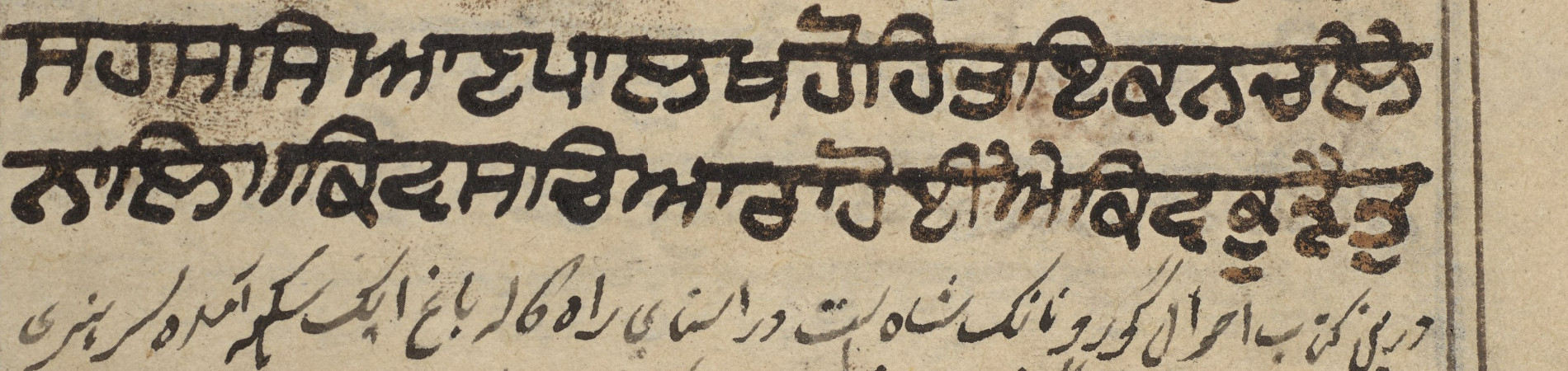
Pothi Sahib with Gurmukhi script with a further annotation in Persian.

Pothi Sahib

The earliest form of a Pothi Sahib was a compilation of written passages passed down from one Guru to the next. These would eventually form the early edition of the Sri Guru Granth Sahib, the Adi Granth, compiled by Guru Arjan Dev Ji and installed in Amritsar in 1604. 

As copies of the Adi Granth were difficult to access for most ordinary Sikhs, Pothi Sahibs were created to contain the more commonly recited passages of the Adi Granth, such as the daily prayers, and others chosen by the scribe. Varying in size, Pothi Sahibs do not have fixed contents, and can be customised to suit the needs of their users or the communities they were created for. 

Pothi Sahibs would normally be used by very wealthy individuals and communities, or by army battalions who did not have easy access to Sri Guru Granth Sahib. Whilst a Pothi Sahib is not a Sri Guru Granth Sahib, it would be treated in a similar manner. 

Originally listed in our catalogue records as a Janam Sakhi, a biography of Guru Nanak, the current consensus amongst Sikh scholars is that this manuscript is, in fact, a Pothi Sahib.

Punjabi MS 4

This Pothi Sahib is customised with passages from the Sri Guru Granth Sahib. Nitnem, Sikh daily prayers, are featured alongside other less commonly recited passages, chosen by the scribe or community. 

Punjabi MS 4


Intriguingly, a Persian annotation under the first page of text reads: 

In this book is the biography of Gūrū Nānāk Shāh. In surveying the road (dar ashnā-I rāh, literally “in knowing the way”) to Kalabagh a Sikh came and the late Sir Henry Elliot Ṣāḥib took it into consideration.

The poor Chehra Gopan Peshawari

We now know, with the assistance of Sikh scholars, that this is not a biography of Guru Nanak, but it is easy to see where the confusion came from. 

The cryptic nature of this annotation leaves us with many questions. Why did they think this was a biography? And what does ‘took it into consideration’ really mean?  


Sir Henry Miers Elliot (1808-53) worked for the East India Company and collected over 450 manuscripts when he was stationed in India, forming his collection between 1840 and 1852.

He served Lords Hardinge and then Dalhousie between 1847–1849 in the Punjab, where he also co-negotiated the treaty that ended the Second Anglo-Sikh War in 1849, for which he was knighted. He remained there until 1852, shortly before his death.

He’s most famous as the author of The History of India as Told by its Own Historians, published after his death.